
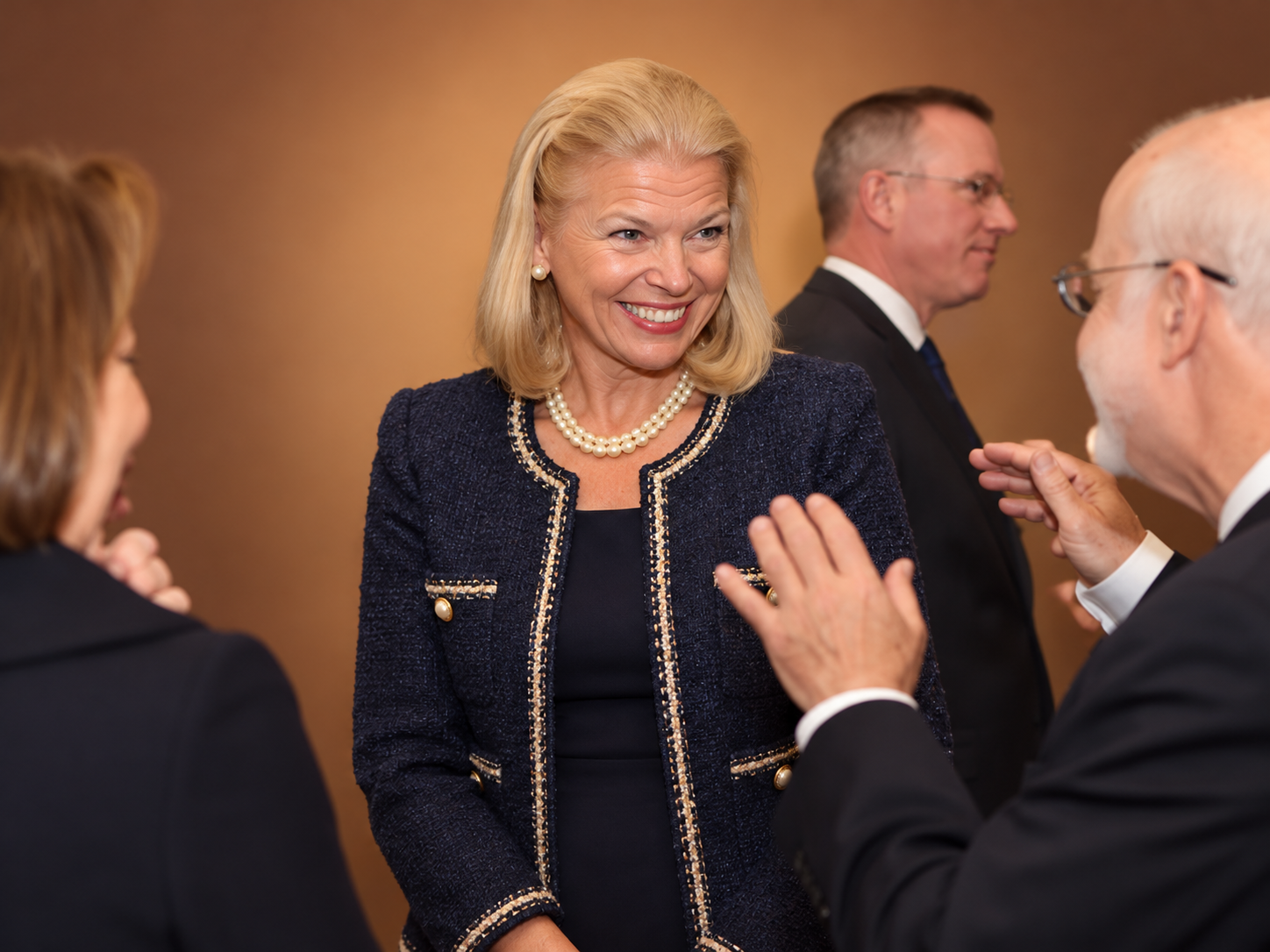
Ginni Rometty and Evan Spiegel are two prominent figures in American technology, but their careers represent different approaches to innovation and business leadership. Rometty became the first woman to lead IBM, one of the world’s most established technology corporations. Spiegel helped create Snapchat and built Snap Inc. into a publicly traded company centered on visual communication and augmented reality.
Their names occasionally appear together in online searches, raising questions about whether they share a personal relationship, professional partnership, or business connection. There is no reliable public evidence establishing that Ginni Rometty and Evan Spiegel are related, married to each other, or involved in a direct business partnership.
What connects them more meaningfully is their influence on the technology industry. Rometty spent decades navigating corporate transformation, artificial intelligence, and enterprise computing. Spiegel developed his career through entrepreneurship, consumer applications, and product innovation.
Understanding their backgrounds reveals how two leaders from different generations have approached technological change, corporate responsibility, and the challenges of running influential companies.
Quick Bio: Ginni Rometty and Evan Spiegel
| Detail | Ginni Rometty | Evan Spiegel |
|---|---|---|
| Full Name | Virginia Marie Rometty | Evan Thomas Spiegel |
| Date of Birth | July 29, 1957 | June 4, 1990 |
| Nationality | American | American |
| Profession | Business executive and author | Technology entrepreneur and executive |
| Education | Northwestern University | Stanford University |
| Primary Organization | IBM | Snap Inc. |
| Best Known For | First woman CEO of IBM | Co-founder of Snapchat |
| CEO Leadership | IBM, 2012–2020 | Snap Inc., since 2012 |
| Major Milestone | IBM’s acquisition of Red Hat | Snap’s 2017 public offering |
| Technology Focus | Enterprise AI, hybrid cloud, computing | Visual messaging, AR, wearable technology |
| Spouse | Mark Rometty | Miranda Kerr |
| Other Public Work | Good Power, OneTen, skills-first employment initiatives | Spiegel Family Fund, Snap Foundation |
Are Ginni Rometty and Evan Spiegel Connected?
The most important distinction is that Ginni Rometty and Evan Spiegel belong to the same broad technology industry but have separate professional histories.
Rometty is associated primarily with International Business Machines Corporation, commonly known as IBM. Spiegel is the co-founder and chief executive officer of Snap Inc., the company behind Snapchat.
Their public biographies do not establish a family connection, shared marriage, formal business partnership, or direct employment relationship.
There is also no verified public record demonstrating that Rometty mentored Spiegel or that they jointly founded or managed a company.
Both have participated in the wider American business community, where executives frequently address issues involving technology, innovation, and corporate responsibility. However, belonging to overlapping professional circles does not establish a personal relationship.
The most useful comparison concerns their careers and leadership philosophies rather than an assumed connection.
Who Is Ginni Rometty?
Ginni Rometty is an American business executive best known for serving as IBM’s first female chief executive officer.
Her full name is Virginia Marie Rometty. She grew up outside Chicago and experienced significant family responsibilities during her childhood. As the eldest of four children, she helped her mother care for her younger siblings.
Rometty studied at Northwestern University, graduating in 1979 with a degree involving computer science and electrical engineering.
She joined IBM in 1981 and developed her career across technical, consulting, sales, and management positions.
One of her significant responsibilities involved helping integrate PricewaterhouseCoopers Consulting into IBM following its acquisition in 2002. The transaction considerably expanded IBM’s global consulting capabilities.
Her experience managing complex business operations helped prepare her for senior executive responsibilities.
In January 2012, Rometty became IBM’s chief executive officer, making history as the first woman to hold the position in the company’s long existence.
Later that year, she also became chairman of IBM’s board.
Ginni Rometty’s Leadership at IBM
Rometty assumed leadership during a period when traditional technology businesses faced major disruption.
Cloud computing, artificial intelligence, mobile technology, and subscription-based services were changing customer expectations.
IBM needed to modernize its operations while continuing to serve large corporate and government clients.
During Rometty’s leadership, the company invested in enterprise artificial intelligence, cybersecurity, cloud infrastructure, data services, and emerging technologies.
IBM Watson became an important part of its public identity as the company pursued commercial applications for artificial intelligence.
One of the defining transactions of her tenure was IBM’s acquisition of Red Hat, completed in July 2019.
The acquisition strengthened IBM’s position in open-source software and hybrid cloud computing. It also demonstrated Rometty’s willingness to make substantial investments in the company’s long-term direction.
Her leadership nevertheless attracted criticism.
IBM experienced difficulties generating consistent revenue growth, while competitors such as Microsoft and Amazon expanded aggressively in cloud computing.
These challenges made her tenure an important case study in the difficulties of transforming an established technology corporation.
In April 2020, Arvind Krishna succeeded Rometty as IBM’s CEO. She continued as executive chairman until retiring from the company on December 31, 2020.
Ginni Rometty’s Work After IBM
Rometty remained involved in business leadership, education, and workforce development after leaving IBM.
She became closely associated with OneTen, an initiative promoting skills-based employment opportunities and improved career access.
Her advocacy emphasizes that professional ability should not always be measured exclusively by traditional university qualifications.
She has also supported broader skills-first employment initiatives, including SkillsRight.
In March 2023, Rometty published Good Power: Leading Positive Change in Our Lives, Work, and World through Harvard Business Review Press.
The book combines experiences from her personal life and corporate career with ideas about ethical leadership, organizational change, and responsibility.
Her post-IBM activities illustrate a continuing interest in how employers develop talent and how technology can support economic opportunity.
Who Is Evan Spiegel?
Evan Thomas Spiegel is an American entrepreneur and technology executive best known as the co-founder and CEO of Snap Inc.
Born on June 4, 1990, in Los Angeles, California, Spiegel developed an interest in design and technology during his education.
He attended Stanford University, where he studied product design.
While at Stanford, Spiegel worked with Bobby Murphy on the application that eventually became Snapchat.
Early accounts of Snapchat’s development also identify Reggie Brown as an important participant in the original concept. A subsequent dispute concerning Brown’s involvement was resolved through a legal settlement.
Snap Inc.’s official corporate biographies identify Spiegel and Murphy as its co-founders.
The application originally operated under the name Picaboo before becoming Snapchat in 2011.
Its central idea was to make photo communication more immediate and less permanent than conventional social-media posting.
Spiegel eventually left Stanford before completing his studies to concentrate on the business. He later earned his Bachelor of Science degree in engineering with a product design focus.
How Evan Spiegel Built Snapchat
Snapchat entered a technology market already dominated by established social platforms.
Instead of concentrating on permanent public profiles, its original approach emphasized short-lived visual messages exchanged between users.
This concept became particularly appealing to younger audiences seeking informal communication.
Over time, Snapchat introduced additional products and features.
Stories allowed users to share collections of photos and videos for a limited period. Lenses introduced creative camera effects and expanded the platform’s relationship with augmented reality.
Discover brought publisher and media content into the application, while Snap Map added location-based experiences.
Spotlight later expanded Snapchat’s short-form video offering.
In September 2016, the company changed its corporate name to Snap Inc., reflecting ambitions beyond a single messaging application.
Snap went public in March 2017, turning the company into a publicly traded technology business.
Spiegel continued serving as CEO, working alongside fellow co-founder Bobby Murphy, the company’s chief technology officer.
By the second quarter of 2026, Snap reported approximately 971 million monthly active users, demonstrating the platform’s substantial international reach.
Evan Spiegel’s Focus on Augmented Reality
Spiegel’s interests extend beyond traditional social networking.
Snap has invested in augmented reality technology, computer vision, camera software, and wearable devices.
The company’s Spectacles project represented an early attempt to combine physical eyewear with digital experiences.
Its later Specs initiatives expanded this vision toward augmented reality computing.
In 2026, Snap introduced additional developments involving SPECS and an AI service called SPECS Intelligence.
These efforts reflect Spiegel’s interest in making digital tools more closely integrated with everyday activities.
However, developing augmented reality hardware remains commercially challenging.
Manufacturing costs, consumer adoption, software compatibility, and competition create significant obstacles.
Snap’s long-term success in wearable computing cannot be assumed simply because it has introduced innovative products.
Different Approaches to Technology Leadership
Ginni Rometty and Evan Spiegel reached executive leadership through fundamentally different routes.
Rometty developed her professional experience inside a major multinational corporation. Her advancement involved managing established departments, overseeing international operations, and eventually directing corporate strategy.
Spiegel helped create a technology product and subsequently expanded the startup into a public company.
These experiences influenced the business problems each executive encountered.
Rometty had to modernize an organization with decades of existing infrastructure, customer relationships, and operational commitments.
Spiegel needed to build a sustainable business around a relatively new consumer technology platform.
For Rometty, innovation often involved acquisitions, enterprise systems, organizational restructuring, and long-term corporate investments.
For Spiegel, innovation has frequently involved product design, user engagement, advertising services, and new ways of communicating.
Neither approach guarantees success.
Established companies can struggle to respond quickly to market changes, while founder-led businesses face uncertainty surrounding revenue, competition, and consumer behavior.
Artificial Intelligence and Their Careers
Artificial intelligence provides another meaningful comparison between the two executives.
Under Rometty, IBM promoted enterprise AI as an important area of investment.
IBM Watson became associated with efforts to apply machine learning and data analysis across industries such as business services and healthcare.
These initiatives also revealed the challenges of translating ambitious AI demonstrations into commercially successful products.
Rometty emphasized the importance of responsible technology development, data stewardship, and preparing workers for changing technological demands.
Spiegel’s involvement with AI has developed in a different environment.
Snap uses machine learning and related technologies across consumer-facing products, including camera experiences, advertising systems, and personalized services.
Its 2026 SPECS Intelligence announcement further demonstrated the company’s ambitions in AI-assisted computing.
The contrast is significant: Rometty’s corporate work focused heavily on the adoption of advanced technology by organizations, while Spiegel has concentrated on integrating technology into consumer experiences.
Business Challenges and Public Criticism
Neither executive’s career can be evaluated solely through achievements.
Rometty faced criticism over IBM’s financial performance and its ability to compete with faster-growing cloud companies.
Although the Red Hat acquisition strengthened IBM’s strategic position, the company’s broader transformation took place amid difficult market conditions.
Spiegel has faced different pressures at Snap.
The company competes for advertising revenue and user attention against much larger technology platforms.
Its operations also involve concerns about privacy, younger users, platform safety, and the economics of developing new hardware.
Snap’s second-quarter 2026 results included revenue growth alongside a reported net loss, illustrating the difference between increasing business activity and achieving consistent profitability.
Both executives demonstrate that technological innovation must eventually be supported by sustainable business performance.
Family and Personal Lives
Public interest in Ginni Rometty and Evan Spiegel sometimes extends beyond their professional achievements.
Rometty is married to Mark Rometty. Her published biography discusses the role of family, education, and personal adversity in shaping her outlook.
Much of her private family life remains outside her public corporate profile.
Spiegel is married to Australian model and businesswoman Miranda Kerr.
The couple married in 2017 and have three sons together: Hart, Myles, and Pierre.
Their blended family also includes Flynn, Kerr’s son from her previous marriage to actor Orlando Bloom.
Spiegel’s public biography identifies Los Angeles as the family’s home.
These verified family details provide no indication of a family connection between Spiegel and Rometty.
Their separate marriages and documented backgrounds are important when distinguishing factual information from unsupported online suggestions.
Philanthropy and Social Responsibility
Both executives have participated in initiatives beyond their commercial responsibilities.
Rometty has focused particularly on education, workplace inclusion, and opportunities for people whose skills may not be reflected by conventional academic credentials.
Her involvement with OneTen and other workforce initiatives reflects these priorities.
Spiegel established the Spiegel Family Fund in 2017 to support charitable work involving education, the arts, housing, and human rights.
He and Bobby Murphy also established the Snap Foundation, which supports opportunities for underrepresented young people in Los Angeles.
Following the 2025 Los Angeles wildfires, Spiegel became involved in additional recovery-related philanthropic work.
These activities demonstrate interests that extend beyond shareholder returns, although the organizations pursue different objectives.
Why Are Their Names Searched Together?
The precise reason individual users search for “Ginni Rometty and Evan Spiegel” is not publicly established.
However, the query naturally raises several questions.
Readers may want to understand whether the executives have a family relationship, whether their companies worked together, or how their achievements compare.
Others may be interested in the contrast between corporate leadership and technology entrepreneurship.
The available evidence supports a professional comparison, not a claim that they share a special personal connection.
It would be misleading to describe them as business partners, relatives, or collaborators without reliable documentation.
Their established achievements are significant enough to discuss without creating an unsupported relationship.
Read Another Topic : Derek Jeter and Hiroshi Mikitani: The Real Connection Between the Baseball Legend and Rakuten Founder
Frequently Asked Questions
1. Are Ginni Rometty and Evan Spiegel related?
There is no reliable public evidence that Ginni Rometty and Evan Spiegel are related. Their available biographies document separate family backgrounds and professional careers.
2. Have Ginni Rometty and Evan Spiegel worked together?
No direct professional partnership or joint company leadership between them has been publicly confirmed. Rometty is best known for IBM, while Spiegel is associated with Snapchat and Snap Inc.
3. Who is Ginni Rometty’s husband?
Ginni Rometty is married to Mark Rometty. Their marriage is acknowledged in her official biographical information.
4. Who is Evan Spiegel’s wife?
Evan Spiegel is married to Miranda Kerr, an Australian model and entrepreneur. They married in 2017 and have three sons together.
5. What is Ginni Rometty best known for?
Rometty is best known for becoming IBM’s first female CEO in 2012. Her leadership included major investments in artificial intelligence, enterprise technology, and the 2019 Red Hat acquisition.
6. Is Evan Spiegel still the CEO of Snap Inc.?
Yes. As of October 2026, Snap Inc.’s corporate leadership information identifies Evan Spiegel as its co-founder and chief executive officer.
7. What can business leaders learn from Ginni Rometty and Evan Spiegel?
Their careers illustrate different approaches to innovation. Rometty’s experience emphasizes corporate transformation, long-term strategy, and workforce development. Spiegel’s experience highlights entrepreneurship, product design, and the challenges of scaling a consumer technology business.
Both careers demonstrate the importance of adapting to technological change while managing commercial risks.
Conclusion
Ginni Rometty and Evan Spiegel are influential technology leaders whose achievements developed through separate careers.
Rometty helped guide IBM through major changes in enterprise computing, artificial intelligence, and hybrid cloud technology. Spiegel helped create Snapchat and continues to oversee Snap’s development in visual communication and augmented reality.
No verified public evidence establishes a personal or direct business relationship between them.
Their real value as a comparison lies in the different challenges they have faced: transforming a long-established global corporation and building a technology company around new consumer experiences.
Together, their careers offer a useful perspective on innovation, leadership, and the changing responsibilities of technology executives.
