
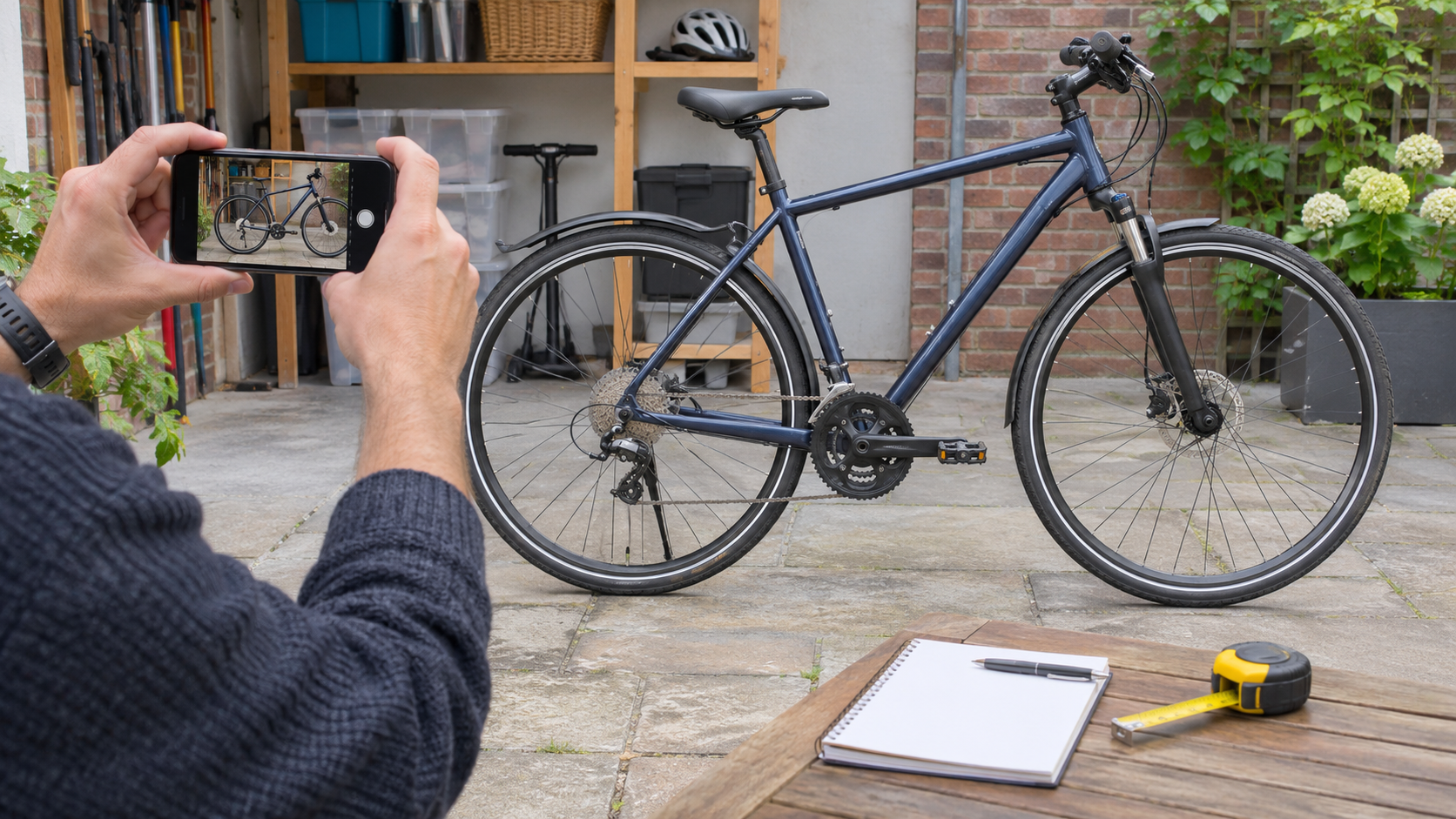
How much is my bicycle worth A practical UK guide to selling, insuring or claiming
Data checked on 5 November 2026
A used bicycle is worth what a well-informed buyer will pay for it today, not a fixed percentage of its original receipt. Start with comparable sold listings, then adjust for age, condition, specification, service history and local demand. For a quick estimate, a UK bike value calculator can provide a sensible range before you compare actual adverts.
That market value is useful when selling or trading a bicycle. It may not be the correct figure for insurance, where policies often use the cost of an equivalent new replacement. Check the wording before choosing a sum insured or making a claim.
- There is no official UK bicycle price book, so sold listings provide the strongest market evidence.
- Asking prices are useful, but completed sales show what buyers actually paid.
- Age matters, although condition and specification can move two similar bicycles far apart.
- Battery condition can materially reduce an e-bike’s value because replacement batteries are expensive.
- Keep the receipt, frame number, photographs and service records before you need them.
Decide which value you need
The same bicycle can have several legitimate values. Confusion usually begins when one figure is used for every purpose.
| Purpose | Useful value | Best evidence |
| Private sale | Likely selling price | Recent completed sales for closely matched bicycles |
| Advert | Asking price | Likely selling price plus a modest negotiating margin |
| Trade-in | Dealer buying price | Written quotes from dealers accepting that model |
| Home insurance | Value required by the policy | Current replacement cost and the policy definition |
| Cycle insurance | Usually equivalent replacement cost | Retail evidence and the policy wording |
| Loss or damage claim | Settlement basis stated in the policy | Receipt, frame number, photographs and replacement quotes |
A dealer must inspect, prepare, warrant and resell a bicycle. Its offer will therefore sit below a realistic private-sale figure. That difference pays for risk, labour, storage and the possibility that the bicycle sells slowly.
How to value a used bicycle in six steps
1. Identify the bicycle accurately
Record the make, model, model year, frame size and original specification. Include meaningful upgrades, but keep the original parts if you still have them. Buyers may value a factory specification more than an unusual conversion.
Photograph the frame number before publishing an advert. Do not display the complete number in public photographs, because a buyer only needs to verify it during the transaction.
2. Find genuinely comparable bicycles
Search completed or sold listings, not only live adverts. Match the same model generation, frame material, groupset, wheel size and approximate condition. A carbon race bicycle should not be compared with an aluminium endurance model sharing a brand name.
Use several sources where possible. eBay completed listings can show transaction evidence, while specialist marketplaces reveal current supply. Local marketplaces help when collection distance materially affects demand.
Ignore suspiciously cheap listings and advertisements with unclear ownership. Police.uk advises buyers to request proof of ownership and check the frame number on a recognised national registration database.
3. Adjust for age without using a rigid rule
Depreciation is usually steepest when a new bicycle becomes used. The curve then slows, although technology changes can create another sharp fall. Rim-brake race bicycles and early e-bike systems show why a universal annual percentage fails.
Age should be a starting point, not the answer. A lightly used five-year-old bicycle with documented servicing can be worth more than a neglected three-year-old example.
4. Price the condition honestly
Assess the frame first. Cracks, serious dents, corrosion and crash damage can overwhelm the value of every other component. If damage may be structural, obtain a professional inspection rather than offering reassurance you cannot support.
Then inspect consumable parts. A worn chain can accelerate wear on the cassette and chainrings. Perished tyres, thin brake pads, leaking suspension and rough bearings all represent costs for the next owner.
Classify condition with observable evidence:
| Condition | What a buyer should see | Typical pricing effect |
| Excellent | Very light wear, correct operation, strong documentation | Upper end of comparable sales |
| Good | Normal cosmetic wear, safe and fully working | Middle of the market range |
| Fair | Working bicycle with service or consumable costs due | Deduct realistic repair costs |
| Poor | Damage, missing parts or uncertain operation | Project or parts value |
Do not describe a bicycle as recently serviced without an invoice or dated record. A buyer cannot verify work from appearance alone.
5. Treat an e-bike battery as a major component
An e-bike valuation needs more than the motor brand and total mileage. Battery age, charging history, remaining range and replacement availability can change the result substantially.
Ask for a diagnostic report when the system supports one. A practical road test can confirm assistance levels, charging and display operation, although it does not measure every aspect of battery health.
Check the current price and availability of a compatible replacement battery. A discontinued proprietary pack creates more risk than an older system with established UK support. Do not open or rebuild a lithium-ion battery to prepare it for sale.
6. Set an asking price and review it
Choose a figure near comparable completed sales, then add a small negotiating margin. Large margins deter informed buyers and leave an advert looking stale.
Review the response after seven to fourteen days. Many saves without enquiries may indicate uncertain collection arrangements. Many questions without offers may mean that essential details or photographs are missing. No meaningful interest usually signals a price above the local market.
What increases a bicycle’s selling price?
Good evidence reduces the buyer’s uncertainty. Keep service invoices, component receipts and a clear record of ownership. Photograph both sides, the drivetrain, controls, tyres, wheels and any cosmetic damage in daylight.
A clean bicycle usually presents better, but aggressive cleaning can cause damage. Avoid pressure washing bearings and electrical components. Remove personal accessories unless they are included clearly in the sale.
Useful upgrades may support value, especially wheels or a current groupset. They rarely return their full retail cost. Highly personal changes, including an unusual saddle or handlebar shape, may add nothing for the next owner.
Season and location also matter. Demand for children’s bicycles often rises before school holidays, while winter can slow some adult categories. Folding and commuting bicycles may attract stronger demand where storage and rail travel matter.
What documents should you keep for insurance?
Requirements vary by policy, so read the current terms. A sensible evidence folder contains:
- the original receipt or another accepted proof of ownership;
- the complete frame number and photographs showing its location;
- dated photographs of the whole bicycle and important components;
- receipts for upgrades, servicing and replacement parts;
- a BikeRegister record that can be transferred after a sale;
- the crime reference number if theft has already occurred.
BikeRegister says its marking kits provide a separate registration identifier and proof-of-ownership record. Police.uk also recommends registering the frame number on a national database approved by Secured by Design.
If the receipt is missing, contact the original retailer before making assumptions. It may retain an order record. An insurer may accept alternative evidence, but only the insurer can confirm what satisfies its policy.
Used value and insurance value are not interchangeable
A bicycle that would sell privately for £900 might cost £1,500 to replace with an equivalent new model. Some policies settle on replacement terms, while others account for age, limits or specified items. The wording controls the claim, not the figure in a marketplace advert.
Check these points before buying cover:
- whether the bicycle must be specified separately above a value threshold;
- whether cover applies away from home and in communal storage;
- how the policy defines an equivalent replacement;
- whether accessories and upgraded components are included;
- which lock rating and locking method apply;
- what proof of ownership and security the insurer requires.
Do not increase a valuation simply because the bicycle has sentimental importance. Insurance and market evidence usually address financial loss, not emotional attachment.
How to avoid underselling your bicycle
First, calculate a range rather than one precise number. Then compare that range with at least five close matches, giving completed sales more weight than hopeful adverts.
Second, separate repair costs from bargaining. If the bicycle needs a £60 service and £40 of parts, either complete the work with receipts or price the work honestly. Buyers often assume a larger problem when a fault is vague.
Third, write a complete advert. Include size, approximate rider fit, collection area, ownership history and known defects. State whether pedals, lights, racks or batteries are included.
Finally, protect the transaction. Meet in a safe place, allow the buyer to inspect the frame number and provide a dated receipt. Transfer the BikeRegister record after payment has cleared.
Frequently asked questions
How can I find out how much my bicycle is worth?
Start with a calculator for an estimated range, then compare completed sales for the same model, year and condition. Adjust for service needs, upgrades and local demand.
How much value does a bicycle lose after one year?
There is no dependable percentage for every bicycle. Brand, category, discounting and condition change the result, so use recent sold evidence instead of a universal rule.
Should I use the asking price or the sold price?
Use completed sales whenever they are available. Asking prices reveal competition, but they do not prove that a buyer accepted that amount.
Does a service increase a used bicycle’s value?
A documented service can support the upper end of the market range. It also removes uncertainty, although the resale increase may not repay every workshop cost.
How do I value an electric bicycle with an old battery?
Check remaining range, diagnostic information and the price of a compatible replacement. Deduct for reduced performance and for uncertainty when the battery is unsupported.
What will an insurer ask for after bicycle theft?
Policies differ, but insurers commonly request proof of ownership, the frame number, a crime reference and security evidence. Check the exact claim requirements before any loss occurs.
Sources and fact check log
This appendix records the source used for each volatile or material claim. Recheck commercial data immediately before publication.
| Fact used | URL | Short source extract | Checked |
| Tyred calculator uses bike type, age, condition and battery health | https://tyred.io/tools/bike-value-calculator | “By bike type, age, condition and, for e-bikes, battery health.” | 5 Nov 2026 |
| UK has no official bicycle price book | https://www.cyclesite.co.uk/bike-guides/how-to-value-a-used-bike | “The UK has no official bicycle price book.” | 5 Nov 2026 |
| Insurers generally need replacement rather than used-sale evidence | https://www.cyclesite.co.uk/bike-guides/how-to-value-a-used-bike | “Insurers usually want replacement value.” | 5 Nov 2026 |
| Police advise checking ownership and registration records | https://www.police.uk/cp/crime-prevention/keeping-vehicles-safe/how-safe-is-your-bike/ | “Ask for proof of ownership and check the bike frame number.” | 5 Nov 2026 |
| BikeRegister marking provides a proof-of-ownership record | https://www.bikeregister.com/news/faq | “provides a proof of ownership” | 5 Nov 2026 |
| Battery condition can materially reduce e-bike value | https://www.cyclesite.co.uk/bike-valuation/electric-bikes | “A depleted battery can reduce value by 30-50%.” | 5 Nov 2026 |
