


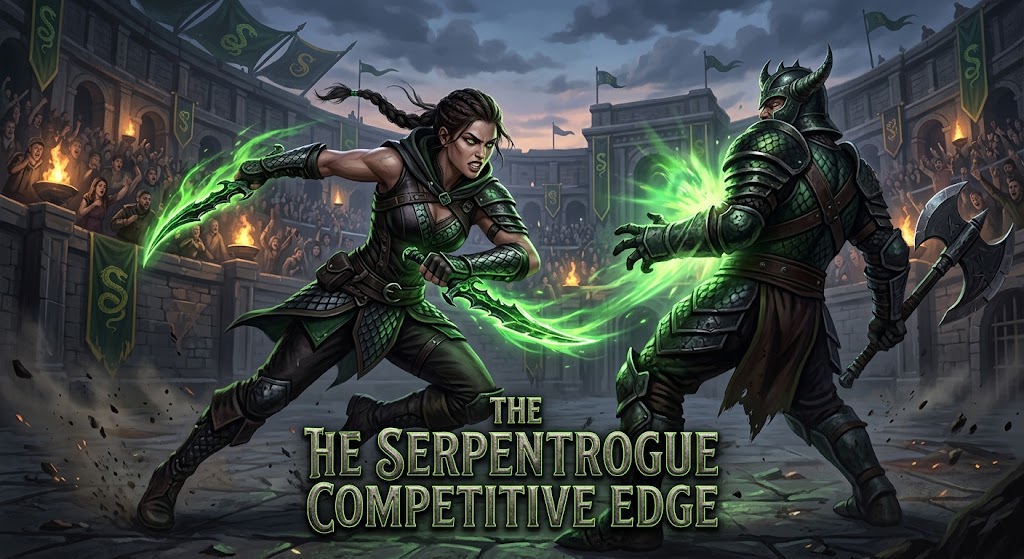
The phrase “the SerpentRogue competitive edge” sounds as though it refers to a special ability, competitive mode, hidden perk, or multiplayer advantage inside The Serpent Rogue. That interpretation is misleading.
The Serpent Rogue is officially a single-player action-adventure game developed by Sengi Games and published by Team17. Steam and Team17 describe a game built around alchemy, exploration, creature interactions, crafting, and the consequences of the player’s actions. Neither official source presents “Competitive Edge” as a named game mode or mechanic.
Instead, the phrase has increasingly appeared in online strategy content as shorthand for something more useful: the knowledge and preparation that make a player more effective at surviving The Serpent Rogue’s interconnected systems. Recent pages ranking for variations of the query use it in precisely that broader strategy sense.
And that interpretation fits the game unusually well. Success does not depend only on swinging a stronger weapon. Researching ingredients, understanding potion logic, watching the Corruption cycle, maintaining stamina, controlling what you carry and knowing how the world reacts to your behaviour can matter just as much as direct combat.
Quick Bio / Game Facts
| Field | Verified information |
|---|---|
| Official title | The Serpent Rogue |
| Search phrase | The SerpentRogue competitive edge |
| Developer | Sengi Games |
| Publisher | Team17 |
| Release date | April 26, 2022 |
| Platforms | PC, Nintendo Switch, PlayStation 5, Xbox Series X|S |
| Game mode | Single-player |
| Genre | Action-adventure / RPG / sandbox with roguelite elements |
| Main character | The Warden |
| Setting | A corrupted medieval fantasy realm around Mount Morbus |
| Core gameplay | Alchemy, exploration, crafting, creature taming and combat |
| Central threat | The Serpent Rogue and its spreading Corruption |
| Official feature called “Competitive Edge”? | No such feature is listed in official Steam or Team17 descriptions |
The release date, platforms, developer, publisher and central gameplay premise are confirmed by Team17 and Steam.
What Does “The SerpentRogue Competitive Edge” Actually Mean?
The simplest definition is system mastery.
There is no ranked ladder or conventional player-versus-player competition to dominate. Steam explicitly lists The Serpent Rogue as a single-player title. The practical “edge” comes from becoming better at predicting what the world will do and preparing accordingly.
That distinction matters because The Serpent Rogue is deliberately built around cause and effect. Team17 explains that the Warden’s actions can alter situations throughout the world. Leaving bodies unburied can attract ghouls, concentrating too many creatures can attract dangerous Reapers, and accumulating too many items can lead to vermin problems.
The game therefore rewards understanding rather than brute force.
A well-prepared player does not simply ask, “Can I defeat this enemy?” They also ask whether the fight is necessary, what the encounter could cost, whether a potion offers a safer solution and whether there is enough time remaining before the environment changes.
Alchemy Is the Foundation of Your Advantage
Officially, alchemy is one of the central systems in The Serpent Rogue. Team17 describes mastering it as pivotal to the Warden’s success. Players collect ingredients, research their properties, experiment with combinations and use the resulting potions in different situations.
That makes alchemy more than a conventional crafting menu.
Before potion ingredients can be properly used for brewing, they must be researched. Research reveals their useful alchemical properties, gradually expanding the player’s practical options.
This creates an important strategic difference between collecting resources and understanding resources.
A bag filled with unidentified ingredients has potential value. A library of researched ingredients gives you usable knowledge.
That knowledge persists as one of your biggest advantages because it changes how you approach future encounters. Instead of depending entirely on whatever weapon happens to be available, you can begin solving problems through effects, transformations, healing and other crafted solutions.
Learn Potion Logic Instead of Memorizing Everything
Potion-making becomes much easier once the underlying structure is understood.
Independent gameplay documentation shows that The Serpent Rogue uses combinations of researched ingredient properties to produce effects. Potions can heal or deal damage, modify attributes, affect hunger and transform or create creatures depending on the formula involved.
This is where experienced play starts separating itself from random experimentation.
Memorizing every recipe is useful, but understanding why ingredients combine successfully is more flexible. It allows you to recognise patterns and make better use of newly researched materials.
It also changes what counts as valuable loot. An ingredient that looks insignificant may complete a formula that gives you a much more effective solution than another sword or consumable.
The competitive edge is therefore not merely “carry more potions.” It is knowing which effect solves the current problem most efficiently.
Treat Corruption Storms as a Timer
One of the most important systems to understand is the Corruption Storm.
According to Gamepressure’s detailed mechanics guide, storms occur in areas including the Wasteland and Swamp when the Corruption counter reaches 100 percent. The storm resets the affected region, renews resources and changes object placement. Characters remaining in the area can die, while unrecovered items may disappear in the reset.
That creates both danger and opportunity.
A new player may see the storm only as punishment. An experienced player can treat it as an expedition clock.
Entering shortly after a reset provides more time for exploration. Entering a dangerous section when the meter is already close to completion creates unnecessary pressure. Likewise, beginning a long fight shortly before the storm arrives may turn otherwise recoverable mistakes into lost equipment.
The reset also replenishes resources, meaning the same system that threatens progress contributes to the world’s renewable gathering loop.
Once that rhythm is understood, storms become predictable planning events rather than sudden disasters.
Protect Yourself From the Real Cost of Death
Death is particularly important because losing a battle can threaten more than health.
When the Warden dies, the character respawns at a safe location while carried items remain at the place of death. Gamepressure reports that dying again before recovering those possessions can cause them to be permanently lost. A Corruption Storm can also remove abandoned items from the affected region.
This changes optimal inventory behaviour.
Carrying every valuable ingredient, rare consumable and specialist tool simultaneously might make the character appear prepared, but it also increases the consequences of failure.
A better approach is to separate expedition equipment from long-term reserves.
Take what the objective requires. Store equipment that has no immediate purpose. Return important discoveries to safety instead of risking everything during one additional encounter.
The strongest run is not always the one carrying the most equipment. It can be the one whose failure costs the least.
Hunger Is Also a Combat Mechanic
The green bar in The Serpent Rogue is easy to underestimate.
It represents hunger, but it also functions as a stamina resource. Attacking and blocking consume it, while insufficient stamina restricts the player’s ability to attack, block and sprint effectively. Resting can restore health but also consumes hunger.
That means food preparation belongs in the same strategic category as weapon preparation.
Walking into a difficult encounter with a nearly empty hunger bar can reduce several options simultaneously. You become less capable of attacking, defending and escaping.
Cooking therefore has direct combat value.
The game includes recipes that restore different amounts of hunger, and cooking becomes increasingly useful as better meals are discovered.
A weapon may determine how much damage you can deal. Stamina determines whether you can keep using it safely.
Inspect Before You Attack
Another significant advantage comes from gathering information before committing to combat.
Gamepressure notes that players can inspect opponents and view information that helps determine whether an encounter is worthwhile. Certain forms or concealment methods can also make observation safer.
This fits The Serpent Rogue’s broader philosophy.
Not every enemy needs to become a duel.
If an opponent has little useful value, fighting may consume weapon durability, food, healing items and time without meaningfully improving the expedition. If the Corruption timer is already high, the opportunity cost becomes even greater.
Combat is therefore best viewed as one tool among several.
Team17 explicitly says challenges can be approached through direct fighting, well-timed alchemy or interactions with local creatures.
Knowing when not to fight is part of mastery.
Blocking Has a Resource Cost
When combat cannot be avoided, defence still requires management.
The combat system allows players to block attacks with appropriate weapons, but blocking draws on the green stamina/hunger resource. Weapon durability also matters; repeatedly absorbing attacks can eventually compromise defence.
This prevents passive blocking from being a completely free solution.
A long encounter can consume several resources simultaneously: health, food, durability, consumables and time before a Corruption reset.
The best outcome is therefore not simply winning.
It is winning efficiently enough that the next objective remains possible.
That principle explains much of The Serpent Rogue’s strategic appeal. Every fight exists inside a larger expedition economy.
Taming Creatures Changes the Equation
Creature interaction is another officially promoted part of the game.
Steam describes The Serpent Rogue as an adventure in which players can tame wild beasts, while Team17 notes that befriending creatures can provide alternatives to straightforward combat.
Followers also have practical utility beyond attacking enemies.
Gamepressure’s beginner guidance notes that followers can carry items, making them useful for inventory management during gathering expeditions.
That means companions can improve both combat capability and logistics.
Used intelligently, they allow the Warden to extend an expedition without personally carrying everything. But because environmental systems and Corruption still affect the world around them, followers should not be treated as disposable storage or unlimited protection.
They are another resource to manage.
Use the World’s Cause-and-Effect Rules
One of the most distinctive parts of The Serpent Rogue is that apparently small actions can trigger larger environmental responses.
Official descriptions give unusually specific examples. Leaving corpses unburied can draw ghouls. Hoarding excessive numbers of items can attract vermin. Keeping too many creatures concentrated together can provoke Reapers.
These mechanics create a powerful lesson: cleanliness and organisation are part of strategy.
A player who repeatedly ignores the aftermath of encounters can unintentionally create a more dangerous environment. Meanwhile, a player who understands what triggers these events can avoid unnecessary complications—or, in some situations, potentially use interactions between creatures to their advantage.
This is one reason the keyword “competitive edge” fits the game despite not being an official feature. Knowledge changes the world you experience.
Shapeshifting Is More Than a Novelty
Alchemy also extends into transformation.
Steam and Xbox’s official descriptions state that the Warden can shapeshift into other creatures through potion effects, providing different abilities and allowing the player to balance human and creature forms.
This expands the meaning of character progression.
Your options are not defined solely by permanent statistics or equipment. The correct temporary form can affect how you approach exploration or a particular obstacle.
Transformation is therefore another example of the game’s preference for problem-solving over raw numerical power.
Players who think only in terms of conventional weapons are using only part of the available toolkit.
A High-Efficiency Gameplay Loop
A reliable SerpentRogue competitive edge can be reduced to a practical routine: begin at a safe location, store items you do not need, prepare food and the potions relevant to your objective, and check what resources or information you still need.
Enter dangerous territory with a specific purpose rather than collecting everything indiscriminately. Watch the Corruption counter. Research creatures and ingredients when possible. Avoid fights that offer little benefit, and use followers when their carrying capacity or assistance has a clear purpose.
Once valuable resources are secured, return them to safety rather than extending the run simply because you still have health.
After a Corruption Storm resets an affected region, the renewed environment can support another targeted expedition.
This cycle turns seemingly chaotic exploration into controlled resource management.
What the “Competitive Edge” Is Not
Several misconceptions surrounding the keyword deserve clarification.
There is no evidence in official Steam or Team17 documentation that Competitive Edge is a named perk, weapon, character statistic, DLC feature, PvP system or multiplayer mode. Steam currently identifies the game as single-player.
It should therefore not be presented as an unlockable mechanic.
Similarly, claims that there is one secret weapon or single build that automatically provides the game’s “competitive edge” oversimplify its design. The official material consistently emphasises combinations of alchemy, exploration, creature interaction and consequential player choices.
The advantage is systemic knowledge.
Why Is “The SerpentRogue Competitive Edge” Searched Online?
The unusual wording appears to have grown through guide-style search content rather than official terminology.
Recent search results include multiple pages using variants such as “TheSerpentRogue Competitive Edge” and “Competitive Edge TheSerpentRogue” to describe strategy, survival and mastery.
That likely explains why users encountering the phrase may wonder whether they have overlooked a game feature.
The verified answer is more straightforward: it is a community and web-content description for becoming more effective at the game, not a term Team17 or Sengi Games uses as the name of a gameplay system.
What Gives The Serpent Rogue an Edge as a Game?
There is also a second reasonable interpretation of the keyword: what distinguishes The Serpent Rogue from other action-adventure games?
Here, the answer is its unusually interconnected systems.
Alchemy affects combat and exploration. Creature transformations create new approaches. The environment resets through Corruption Storms. Player behaviour can produce ecological consequences. Hunger doubles as stamina. Followers can support both fights and resource transport.
Critics did not agree on every part of the execution—the PC version has a 72 Metascore based on seven listed critic reviews—but several reviews highlighted the game’s crafting, exploration and unusual systems as notable strengths.
Its identity comes less from one revolutionary mechanic than from how those mechanics interact.\
Read More : u373378069: What Is It? Verified Facts, Meaning and the U-373MG Confusion
Frequently Asked Questions
Is Competitive Edge an official feature in The Serpent Rogue?
No official Steam or Team17 description lists a mechanic or mode called Competitive Edge. The phrase is primarily used online to describe strategies that improve a player’s effectiveness.
Is The Serpent Rogue multiplayer?
No. Steam lists The Serpent Rogue as a single-player game.
What gives players the biggest advantage?
Understanding alchemy, researching ingredients, planning around Corruption Storms, managing hunger and inventory, and avoiding unnecessary fights are among the most important advantages supported by the game’s documented mechanics.
Who developed The Serpent Rogue?
The game was developed by Sengi Games and published by Team17.
When was The Serpent Rogue released?
It launched on April 26, 2022, for PC, Nintendo Switch, PlayStation 5 and Xbox Series X|S.
Why are Corruption Storms important?
They reset affected areas, renew resources and change object locations, but they can also kill characters remaining inside and remove unrecovered items. Understanding the timer is therefore critical to safe exploration.
Can creatures help the Warden?
Yes. Creature taming is an official part of the game, and followers can assist with practical tasks such as carrying items in addition to helping during adventures.
Conclusion
The SerpentRogue competitive edge is not a secret perk or competitive multiplayer feature. It is mastery of The Serpent Rogue’s systems.
The strongest players learn how ingredients work before wasting them, use alchemy as a problem-solving tool, maintain enough food for combat stamina, watch Corruption Storms carefully and limit how much valuable equipment they expose to death. They inspect situations before attacking, use creatures and followers intelligently, and respect the consequences their actions can create throughout the world.
That approach matches what The Serpent Rogue was designed around. Team17 repeatedly describes a game where experimentation, alchemy, environmental consequences and different approaches to danger matter alongside traditional combat.
In other words, the real competitive edge is simple: know more, prepare better, and make every expedition deliberate.
